Physical Address
304 North Cardinal St.
Dorchester Center, MA 02124
Physical Address
304 North Cardinal St.
Dorchester Center, MA 02124
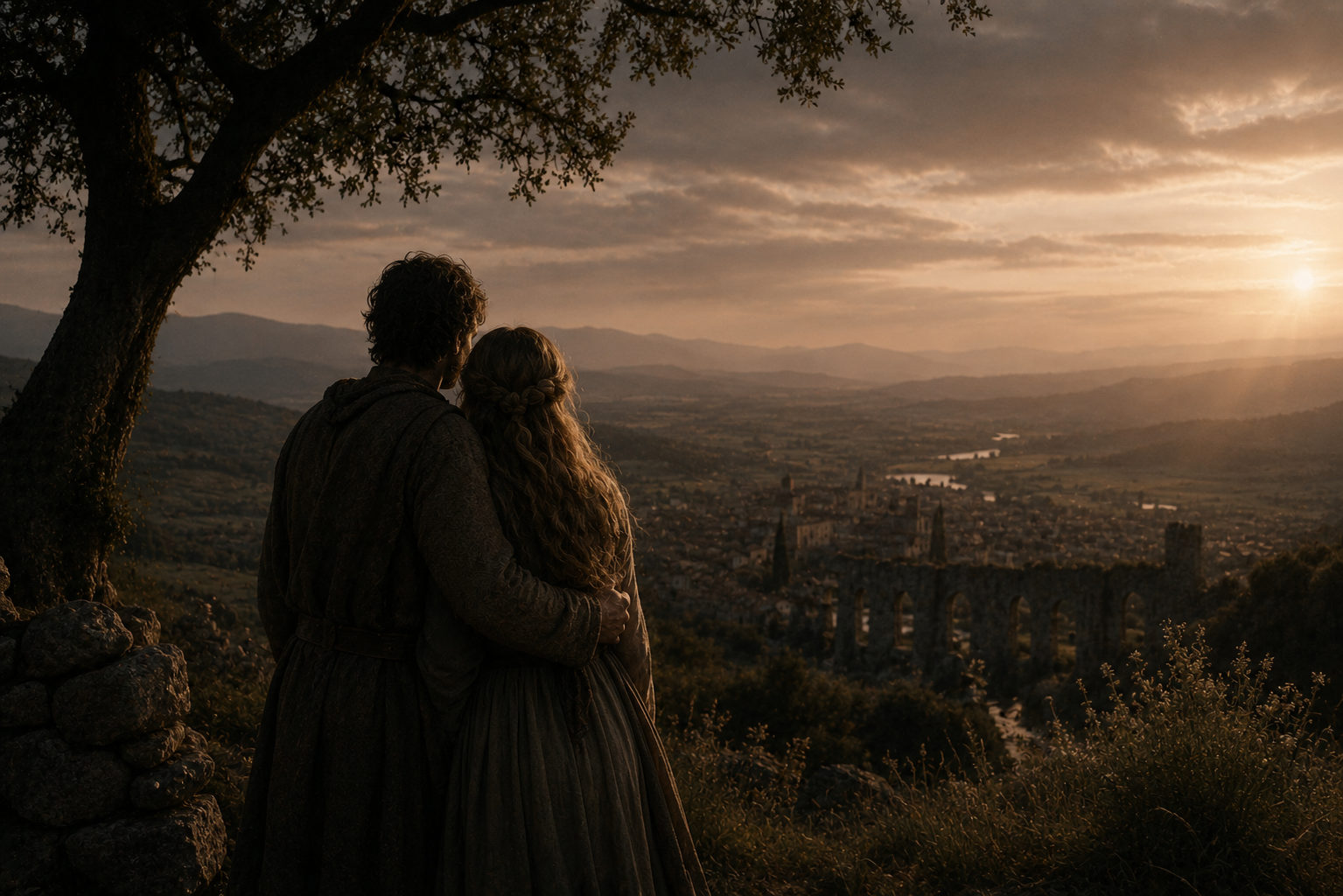
Hearing that a close friend had found the courage to court the woman he loved led me to reflect on something far greater than romance. To choose another, and to be chosen in return, may be among the deepest responsibilities—and greatest miracles—of human existence.
In a call with a good friend, he told me that he had found the courage to court a young maiden in whom he had long taken an interest. By the grace of God, she accepted his courtship. Blessed be the connection of these two souls, and may it bear fruit, now and for years to come.
I am, I hope, a romantic, and few things fill my heart with more joy than seeing two people choose one another. When the heart triumphs over both thought and flesh, and those of righteous intention dare to try. I truly hope that this is the case here. I believe it is.
However, I have never been known to be the sharpest knife in the drawer. I would not recognize bad intentions if they struck me in the face—which they have, on more than one occasion. Neither I nor anyone else can see the future, nor can we truly know the purity of another’s heart.
A person may enter a relationship in an attempt to heal wounds carried since childhood, searching for the parent who never loved them in the face of another. They may delight in how someone affirms the persona they have carried for decades, or become captivated by the pleasure that person brings. Perhaps they speak to our lower desires, and we lack the strength to deny the impulses of the flesh. Perhaps we love the feeling they give us more than we have ever loved them.
The reasons for unrighteous relationships are endless when viewed in their particular circumstances. Yet the purpose of this reflection is not to frighten, but to encourage. It is an attempt to uplift the mystery and beauty of love.
To enter into a relationship with another is no simple matter, as most people know. Curiously, the harder we seek it, the further away it often seems to drift. What, then, makes the relationship to another so immensely difficult?
I do not know.
But I do know this: to connect with, trust, and love yourself is already an immense undertaking, seemingly impossible for those brave enough to attempt it. To then unite this life with someone else—someone every bit as complex as yourself—multiplies the task.
If you have not yet come to peace with the faults you believe you possess, that shame will inevitably spill over onto the other. To bring into alignment what you are, what you want, what you hope for, what you think, what you feel, and what you do, is itself a lifelong undertaking.
Then comes something even greater. To allow parts of yourself to die. To make room for what another person is, what they want, what they hope for, what they think, feel, and do.
The union of one person with another may shape not only two lives, but generations, and through them, the future of the world itself.
Blessed are we to be given the opportunity to restore, in love, what ignorance once tore down.
That a person carries immense responsibility and importance is, to me, beyond dispute. This may be experienced either as a great burden or as a great opportunity. Whichever way we choose to perceive it, the fact remains: a person is.
A person exists, which means they are part of that which is. And that which is, is all that there is. Nothing exists outside it. To exist, therefore, is to participate in reality itself.
Every person directly influences all that they come into contact with, and indirectly influences countless things beyond their immediate reach. Everything we consume affects the world. Every person we meet is, in some measure, changed by us. Every decision we make—or fail to make—alters that which is.
To exist is to participate in the physics of the whole. According to the law of gravitation, every mass exerts an unavoidable pull upon every other mass in the cosmos. When an individual moves, however imperceptibly, the entire universe adjusts. We see something similar in the laws of thermodynamics, where human action is simply another transformation of the universe’s finite energy.
An individual cannot choose not to have an impact. Because we are physically continuous with that which is, our local actions ripple outward. Whether great or small, our choices become part of the unfolding trajectory of existence itself.
Although this may seem abstract, it does not diminish the importance of the point. What you do today shapes tomorrow. What you say alters another person’s attention, feelings, and interpretation of life.
Is there anything so seemingly urgent, so all-consuming, as love and the connection to another? Is there anything that can lift the human spirit more than returning to that which cannot truly be explained—except perhaps as a home we have somehow always longed for, despite never having known it?
To allow another person to become part of the reality that is you, and for them to allow you to become part of the reality that is them, ought to be regarded as nothing less than a miracle.
As already stated, the responsibility you carry toward yourself has, in this meeting of two lives, become doubled. The abstract and unseen influence that your being exerts upon the world has now been given a face. A mirror of all that you are.
Another soul, who, like you, once stood alone as an individual “I.” The illusion of separation begins to dissolve. There is no longer merely you. There is now us.
The concentrated identity you once believed yourself to be is no longer entirely your own. You become intertwined with another, much like particles that lose their independent identities and become part of a single, indivisible system. It is difficult for me to think of a better image than quantum entanglement.
“You have chosen, and you have been chosen. You are now in active participation of one another.”
In Plato’s Symposium, the comic playwright Aristophanes tells of a humanity very different from our own.
These primordial human beings were spherical creatures with four arms, four legs, two faces looking in opposite directions, and two sets of genitalia. They were extraordinarily powerful, self-sufficient, and complete. Yet with that completeness came immense pride. They dared to climb the heavens and challenge the gods themselves.
To humble them, Zeus split each being in two.
Apollo then healed their wounds, drew the skin together, and tied it at the navel as a lasting reminder of what had been lost.
Thus, the individual “I” was born. Fragments of an original whole. Aristophanes tells us that the severed halves embraced one another so desperately that they refused to eat, sleep, or care for themselves, longing only to become whole again. Many, he says, simply wasted away and died from grief.
Perhaps there is something profoundly true in this myth. Perhaps we are not entirely whole. Perhaps the “I”—our sense of separate self—is itself the wound left behind by pride. Perhaps the longing we carry, the desire to gather together the shattered pieces of existence, is expressed through our search for what we call our “other half.”
Whether Aristophanes intended this literally, I do not know. Nor do I know whether the myth is true in the way it presents itself. But I do know this: Few desires seem as fundamental as our longing to love and be loved. That appears to have been true thousands of years ago, and it remains true today. With that recognition comes another.
If our deepest longings are not accidental—if they belong to our very nature—then perhaps they also point toward a purpose.
If that is so, what could be more important than the union between two people?
People may argue that the greatest step in the progression of the human race was the Neolithic Revolution, when we transitioned from hunting and gathering to agriculture, laying the foundations for civilization itself. Others might point to the Industrial Revolution, when craftsmanship gave way to machinery and the assembly line reshaped the world.
But perhaps it was neither.
Perhaps the greatest step in human history occurred the moment one person willingly laid down their life—both metaphorically and, when necessary, literally—for the love of another.
What lies at the foundation of all action? I would argue that it is care. If you do not care, you will not act. No one can truly be forced to pursue what they do not value. Action always follows care.
And if there is any form of care that reaches beyond the individual, it is the care for another person. Is it not this care that has become the foundation of everything we know? Is it not the love between two people that gives rise to children—to new conscious lives that continue the story? And is not the child one of the purest expressions of unrealized potential? And is it not the care for one’s partner and one’s children that which compels us to put the world into order?
When we look back through history, we often speak of kings, empires, and victories. Yet I wonder whether history has always been moved by something much quieter. When approximately eight thousand defenders stood upon the walls of Constantinople against an army many times their size, was it truly glory that kept them there?
Perhaps for a few.
But I cannot help believing that, for many, they stood because there were people they loved behind those walls.
Not merely an empire. Not merely a city.
But their wives. Their husbands. Their children. Their homes.
For is it not Love that often appears in history wearing the clothing of duty.
Whatever one believes about the sanctity of marriage, the instinctive recognition that the weight of existence is difficult to bear alone has remained a constant throughout human civilization.
To be chosen by another—and to choose another in return—is among the greatest miracles available to us. Like the birth of a child, the flowering of spring, or the certainty of each sunrise, it reminds us that existence continues to offer gifts that no amount of explanation can diminish.
Anthropologically, there is no known civilization that lacked some form of ritual binding two people together. Empires rose and fell. Governments changed. Religions divided. Yet the union of two people remained one of the enduring foundations of human life. Perhaps there is a reason that traditional marriage vows are so absolute:
For better or for worse.
For richer or for poorer.
In sickness and in health.
Until death do us part.
These vows are remarkable because they are designed to outlast emotion. They bind us not only to another person, but to something greater than ourselves.
Whether we understand that greater reality as God, society, nature, or existence itself matters less than the recognition that love asks something of us beyond preference.
Some may argue that these reflections place too great a burden upon the individual, or that the sanctity of lifelong union belongs to another age.
Perhaps.
Yet I have never met anyone who, by nature alone, truly grasped the extraordinary gift of simply existing. For many, encouragement to recognize their own dignity remains one of the greatest kindnesses we can offer.
Whatever direction society takes, and whatever forms relationships may assume, I suspect one thing will remain unchanged.
The longing to find a place where one’s life may rest securely in another will endure.
May these words serve not as a burden, nor as a warning, but as an invitation.
An invitation to recognise the extraordinary opportunity that love presents.
For those fortunate enough to encounter another soul with whom they may walk through life, may they carry that responsibility as a badge of honor.
Not because love is easy. But because they dared to choose. And because they were chosen.
If these reflections contain any truth, then let those who have taken the time to read them remember this:
Everything of great value carries a cost.
For those still searching, remember that the very longing you carry is itself evidence that the treasure exists. For those who have found it, remember that what has been entrusted to you was never guaranteed.
Many will search and never find. Others will never have the opportunity to seek at all. Some will never again look into the eyes of the person they love.
For that reason alone, gratitude seems an appropriate response.
Few things have filled my heart with hope more than hearing of my friend’s courage to court the woman he loved.
Perhaps one day, I too, will find the courage to give myself so completely to another.
And even if that day never comes, it is enough to know that one young man—and thousands like him—continue to take that step.
That alone reassures me that love is not merely an accident of existence, but something woven into its very fabric.
May every blessing be given to those who dare to try.