Physical Address
304 North Cardinal St.
Dorchester Center, MA 02124
Physical Address
304 North Cardinal St.
Dorchester Center, MA 02124


We often assume that our strongest impulses reveal what we truly need. Yet, like the warm shower that cools the body more effectively than a cold one, our deepest needs are sometimes hidden beneath the very reactions that seem designed to satisfy them. What if maturity begins by learning to distinguish the two?
On the question of factors that contribute to good sleep, many answer: darkness.
This seems obvious. Sleep is associated with night, and night is when the sun goes down. Yet something else happens when evening comes: the temperature falls. For healthy sleep, our body temperature gradually decreases as the body prepares for rest. Recommendations for good sleep therefore often include sleeping in the dark and lowering the temperature. The advice, however, is often too general to be practically useful. The first response to the recommendation to “lower your temperature before sleep” is often that you can use a cold shower to achieve this. However, aggressively lowering your body temperature with cold water has the opposite effect. The body seeks homeostasis, and the sudden drop in temperature causes it to increase its core temperature after the shower. A more effective solution is the counterintuitive one: take a warm shower. Afterwards, the body naturally lowers its temperature, leaving you cool and comfortable when you go to bed.
This pattern may also be true of ourselves.
What we need and what we believe we want often seem to stand in contradiction. Not because of ill intent, but because of misunderstanding (that we do not know or grasp) or faulty perception of the value or purpose of the need (that we judge a need as wrong or inappropriate).
Many years ago, I almost sawed my thumb off on a construction site on a Friday afternoon. This made me feel, and see myself, as rather stupid and incompetent, despite having many years of experience with tools and equipment. I was given, if I remember correctly, seventeen stitches: eleven in the tendons and six in the skin. At the time, I had no concept that I should address, or even care about, an almost missing limb. The injured thumb stood in the way of the persona of competence I wanted to project, so I ignored it and played it off. My arm was placed in a cast from the elbow to the thumb.
Some weeks later, I had been invited to a dinner. I reached across the table to take a piece of bread that needed to be cut with a bread knife. Since the thumb on my left hand had been injured, I struggled to hold the bread steady. Someone offered to help, but I strongly declined. As a result, I could neither control the bread nor use the fine motor skills of my left hand properly. Instead of cutting the bread, I cut my index finger. I now have two super cool scars that no one could ever know came from my inability to meet myself with humility.
In cultures that prize achievement, a sense of rest and calm may be indirectly regarded as something negative. What disappears is our ability to recognise the need beneath the reactions that once served a purpose. Negative experiences in social engagements or relationships, for example, often do not lead us to long for more relationships, but rather fewer.
Identity functions to preserve coherence. People rarely interpret painful experiences as isolated events. Instead, they construct broader narratives that make the suffering intelligible. These narratives may conclude that others cannot be trusted, that relationships are inherently dangerous, or that one is fundamentally unworthy of love. Although these conclusions differ, they share a common function: they reduce uncertainty by providing an explanation for repeated pain.
This may be seen most clearly in our emotional needs. An unmet need for care or recognition may be expressed through aggression or force. Likewise, a lack of felt love or appreciation may be expressed through isolation or avoidance.
Research on loneliness provides a well-established example of this phenomenon. John Cacioppo and Stephanie Cacioppo argue that perceived social isolation does not simply create a desire for social contact. Rather, loneliness increases hypervigilance toward potential social threats. Individuals become more attentive to signs of rejection, interpret ambiguous interactions more negatively, and consequently withdraw from situations that could otherwise satisfy their need for belonging.
Although loneliness provides one of the clearest demonstrations, the same pattern appears across many emotional needs. Experiences of humiliation may produce avoidance of recognition. Betrayal may inhibit trust. Repeated rejection may lead not merely to sadness but to an increasing expectation that rejection is inevitable. The unmet need changes the way reality itself is perceived.
The consequence is deeply paradoxical. The need remains, and may even grow stronger, while the cognitive processes responsible for protecting the individual simultaneously reduce the likelihood that the need will ever be fulfilled.
These expressions are tendencies that give us clues about how perception operates. They should not be understood as universal laws of nature.
The examples considered differ in content but share a common structure. Cold leads us to seek warmth, yet a warm body seeks to become cool. Loneliness produces a need for connection, yet a heightened need for connection may also increase the perception of threat. Injury creates a need for care, yet care may produce a perceived sense of weakness that causes us to neglect it. The need, however, never disappears. It remains in the background, hidden behind protective strategies and interpretations that once seemed necessary for survival.
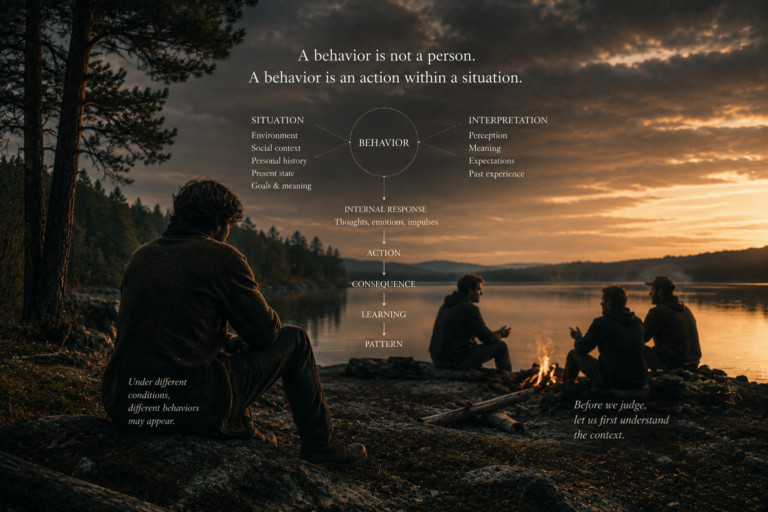
If the behaviours we act out do not fulfil our deeper needs, then those behaviours deserve to be questioned. What behaviours do I repeatedly act out? What do these actions lead to? Is this behaviour bringing me closer to the need I seek to fulfil, or further away? The practical implication of recognising these paradoxical behaviours is to observe oneself without judgement. To allow an honest observation of recurring patterns that may reveal unmet needs within ourselves. Such observations ought to be met with understanding rather than condemnation.
Like the warm shower before sleep, many of life’s deepest problems resist intuitive solutions. Our reactions and impulses naturally occupy our attention and suggest the easier road of comfort and convenience. Yet the very impulses that seek to protect us from discomfort and pain often fail to guide us toward health and fulfilment. To take responsibility for oneself—or to grow up, so to speak—may not be to satisfy every desire, but to recognise and reconnect with the deeper needs of our being, hidden beneath reactions that no longer serve us.