Physical Address
304 North Cardinal St.
Dorchester Center, MA 02124
Physical Address
304 North Cardinal St.
Dorchester Center, MA 02124

A small bird flew into my home by mistake. What began as an ordinary encounter soon revealed something far less ordinary: how quickly I judged what I did not expect, and how easily compassion disappears when beauty gives way to decay.
After a walk, I entered my living room. The window stood open. Soon I heard something moving beneath my desk, which struck me as strange. I looked down and saw that a bird had flown in from outside, where I keep my bird feeder.
I instantly started to smile, for two reasons.
First, I often see the birds perch on the windowsill and peek inside, and I have often laughed to myself that one day one of them would eventually fly in.
Second, the bird was not stressed. It simply hopped around beneath my desk—from cable to wastebasket—without a care in the world.
My mind immediately interpreted the bird through the lens of predictive processing. I assumed it was one of the sparrows I see outside my window every day. In psychology, this is referred to as a pre-established perceptual set. At first glance, and based only on its general shape, I processed the image from the top down. I expected to see a sparrow.
But as I wondered whether I ought to help it find the window again, I looked more closely.
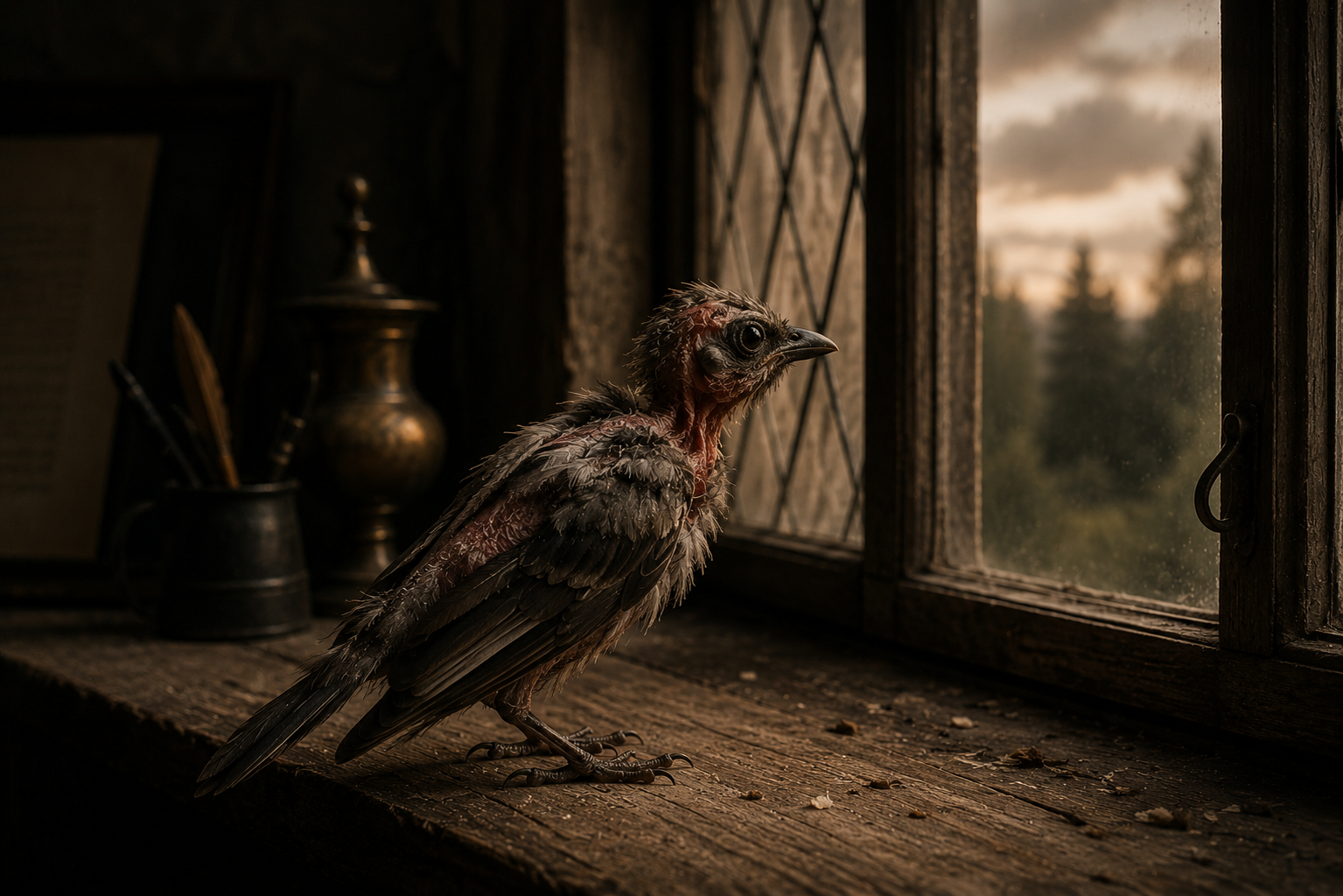
The bird was grey and puffed up, with patches of exposed red skin. It was molting. It had lost most of the feathers from its head and neck, giving it the appearance of a tiny vulture. Its eye was pitch black, like an empty eye socket set into a grey bird skull.
I froze.
It immediately brought back memories of other encounters with dying birds. Memories of finding dead animals in the forest while crows pecked at their eyes, almost seeming to laugh at me.
This little bird, however, paid me no attention at all. Standing barely a meter away, I was of no concern to it. After a moment it hopped onto the windowsill and quietly flew away.
A direct prediction error had occurred. I felt shock and disgust. I had not seen a bird. I had seen disease.
Where had it come from? Why had it behaved so nonchalantly? Why had I never seen it before?
This type of molting is unusual, though it does happen from time to time. I have seen it before in other birds. It can sometimes result from parasites or disease, most mostly it is part of the natural process.
After gathering myself and organizing my thoughts, I felt a deep sense of shame. Why had I chosen to judge a molting bird? Why did I respond with shock and disgust simply because it did not appear as I expected? Why had I not expected such a thing?
Do I not know that birds gather outside my window? Do I not know that birds molt? How could I condemn a bird for passing through a process of renewal? It had merely taken a wrong turn and, by accident, visited my home.
Would I judge a person the same way?
Would I condemn someone who was simply trying to find their own way?
Would I cast judgement upon another who was passing through a difficult process of renewal?
How could I possibly justify such a response? If the bird could speak, would I condemn it as I had already condemned it within my own thoughts?
What a monster I am. Please forgive me.
“My apologies, good sir. I seem to have taken a wrong turn at the ash tree.” (The molting bird.)
“What is this that my eyes behold? What are you doing in my home? Not only are you an intruder, but you are vile and resemble a corpse!” (Me.)
“I mean no harm. This molting process drains all my strength. It demands more of my body than you know. I simply made a mistake.”
“Well, you are unpleasant to look at, and I would like you to leave.”
“Show mercy. I thought that, in your heart of hearts, you wished to do good. You feed us birds every day. I believed you would understand.”
“Well, I don’t. Leave, and do not return. You offend my eyes, and you ought to be ashamed for defiling my home with your presence.”
I truly hope that I would never speak to a molting bird in such a manner if given the chance. I want to believe that I would remain as kind to it as I try to be toward others.
Yet this encounter led me back to something I have contemplated for many years.
To do good, and to possess a noble character, is not proven in moments when goodness costs us nothing. It is easy to imagine ourselves compassionate when compassion is never demanded of us. It is easy to believe ourselves virtuous while our virtue remains entirely hypothetical.
“The human soul is deeper than hell, because hell doesn’t pretend to be good.”
— Fyodor Dostoevsky
For a long time I have been puzzled that so few seem to recognize that the story of Cain and Abel is, above all, the story of oneself. The darkness that resists goodness in the world also exists within me.
A person may never truly understand how capable of evil they are until they have sincerely tried to become good.
And for those who have never been forced to choose what is right over what is easy, how can they confidently declare themselves either good or evil?
All it took was for a bird not to appear as I wanted a bird to appear.
That alone was enough for me to condemn it.
A living creature, simply passing through one stage of its life.
And my immediate response was to think,
“You are no longer acceptable to me.”
Who am I to judge such things?
Would I still feed the birds outside my window if they no longer possessed the beauty I expect of them?