Physical Address
304 North Cardinal St.
Dorchester Center, MA 02124
Physical Address
304 North Cardinal St.
Dorchester Center, MA 02124

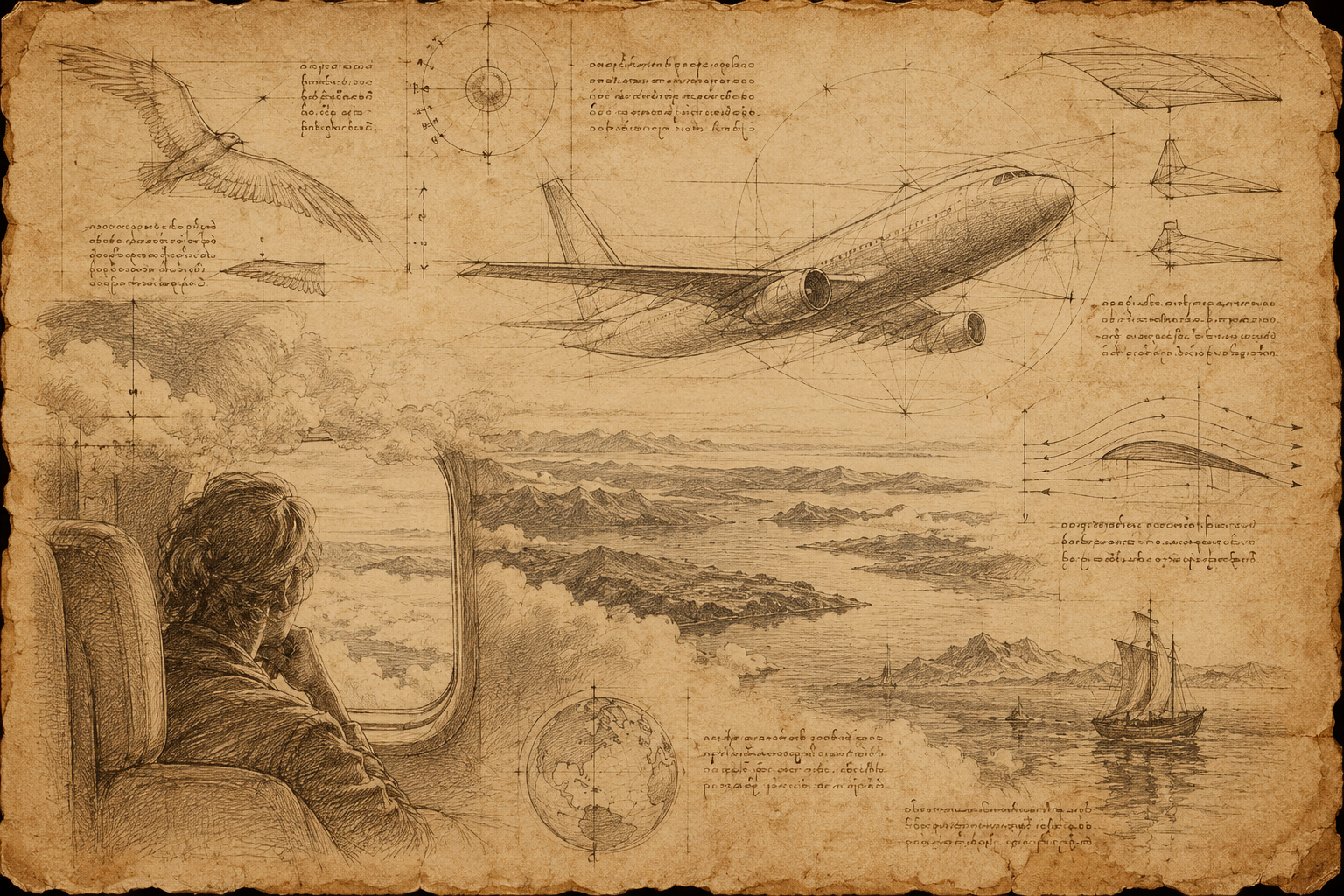
What happens when the extraordinary becomes ordinary? During a flight to Lisbon, I found myself reflecting upon the marvels we have ceased to notice, and how familiarity shapes our perception of life. An exploration of attention, wonder, and gratitude—not merely as a pleasant emotion, but as a capacity through which we may participate more fully in life.
During my flight to Lisbon, I found myself amazed by the marvels of flight. How remarkable it is that a machine of such enormous weight may take to the skies, carried by the very air that surrounds us. That which we cannot see, and seldom give much attention to, may hold us above the earth as water holds a ship upon the sea. Air itself is a gas, a part of this material world, and why should it not, after all, possess properties that allow us to float upon it? Yet the understanding of how something works does not make it any less remarkable.
It is an extraordinary experience to travel through the air, to look down upon the clouds, the mountains, the oceans, and the little constructions of man. To be transported from one part of the world to another in a matter of hours. It is, if you allow it, a source of tremendous excitement and wonder.
But as I sat at the airport waiting for departure, I could not help but observe the apparent absence of this wonder in those around me. There seemed to be little excitement about the journey that awaited us. Rather, an atmosphere of boredom, impatience, and occasional annoyance. People occupied themselves with their phones, complained about the waiting, or simply sat in anticipation of arriving somewhere else.
And I began to wonder: How come?
Have we become so accustomed to flight that we no longer regard it as the immense miracle that it is? Has the experience become so commonplace that it no longer deserves our attention? Or have the images of film and television, through which we may witness almost anything imaginable, made even the most extraordinary achievements of mankind appear trivial?
I remember hearing that travelling by air was once an occasion for which people dressed with particular care. To wear a suit and tie was not uncommon, and the experience itself seemed to carry a certain sense of dignity and occasion. Today, no such thing appears to be the status quo. I myself sat in linen trousers and barefoot running shoes, and I do appreciate the comfort. But I wonder if something of the respect and appreciation for the experience has been lost along the way.
The clothing itself is of little importance. It is rather what the clothing may once have represented that interests me. That the traveller was conscious of participating in something extraordinary.
And this brings my thoughts towards the sea.
At some point in our history, a human being must have discovered that he could take to the waters. That by arranging materials in a particular manner, he might float upon that which otherwise would swallow him. Imagine the first person who dared to leave the shore, carried by something he could neither stand upon nor command. What an extraordinary experience that must have been.
Yet today, boats are everywhere. We cross rivers, lakes, and oceans with little consideration for the miracle of the thing itself. The ship has become a means of transportation, just as the aircraft has become a means of travelling from one airport to another.
But has anything really changed?
The water still carries the ship. The air still carries the plane. The laws of nature have not become less remarkable simply because we have learned to make use of them.
It is not the world that has become ordinary, but our perception of it.
There is something peculiar about the human mind in its relationship to familiarity. That which we encounter repeatedly gradually ceases to demand our attention. What once filled us with excitement becomes expected, and what is expected may eventually pass almost entirely unnoticed.
This is, in many regards, a remarkable ability. If every ordinary experience demanded the same attention as the first, I wonder how we would ever manage to direct ourselves towards anything else. The mind must, in some manner, learn what may be regarded as familiar and what requires further examination.
But what is useful for the operation of the mind may not always be beneficial for our experience of life.
For if the familiar ceases to be perceived, and the extraordinary becomes familiar, might we not gradually lose our appreciation for the very things that make life worth experiencing?
Consider the simple act of drinking water. That a substance exists which may enter the body and sustain its life. That the earth provides it, that it falls from the heavens, gathers in rivers and lakes, and becomes part of the very organism through which we experience the world. Yet how often do we drink a glass of water without giving it the slightest consideration?
Or the act of walking. That through the cooperation of muscles, nerves, bones, and the innumerable processes of the living organism, we may rise from a chair and carry ourselves across the room. Something so ordinary that we seldom consider it an achievement at all.
Until the ability is taken from us.
Then that which was once ordinary may become the greatest of gifts.
And I wonder whether we must first lose something before we are able to appreciate that we ever possessed it.
Our experience of the world is not merely a consequence of that which surrounds us, but also of the attention through which we meet it.
Two people may sit beside one another in the same aircraft, looking through the same window, witnessing the same clouds and the same earth beneath them. Yet one may experience boredom while the other is overcome by wonder.
The world presented to them is, in many regards, the same. But the world experienced is not.
What then accounts for this difference?
It is not only what we see, but how we have learned to see. The interpretations, expectations, and habits of attention through which we meet the world determine, in part, what the world may reveal to us.
If I approach an experience with the presumption that nothing of interest is to be found, I wonder how much I will actually discover. But if I approach the very same experience with curiosity, with a willingness to observe and to be surprised, something that has always been present may suddenly become visible.
The aircraft has not changed. The water has not changed. The body has not changed.
But the observer has.
And this is one of the more important aspects of our relationship to life: that we may cultivate not only our ability to think and to act, but also our ability to perceive. To see that which has always been before us, but which we have ceased to notice.
I have often thought of gratitude as a response to something good that has happened. That we receive a gift, experience kindness, or find ourselves in favourable circumstances, and consequently feel grateful. But I have come to understand gratitude not merely as an emotional response, but as a capacity that may be cultivated through the deliberate direction of attention.
For what benefit is gratitude to the individual? Why ought we to cultivate this capacity rather than simply await the circumstances that give rise to it?
Consider how easily our attention becomes occupied with what we lack. The work that remains undone, the opportunities that have passed, the money we have not earned, and the life we have not yet managed to create. These concerns may be entirely legitimate, but when they occupy the whole of our perception, what remains of our ability to recognise the means by which we might improve our circumstances?
For the attention we direct influences what we perceive, what we perceive informs our interpretations, and these interpretations affect our emotions and willingness to act. A man who sees only what is missing may find himself overcome by dissatisfaction, while the very capacities and opportunities through which he might act remain unnoticed.
Gratitude is therefore not merely the cultivation of a pleasant emotion. It is the deliberate recognition of what is present, what is good, and what may be made use of. It allows us to meet our circumstances with a more complete perception of reality, rather than through the narrow interpretation of what we wish were different.
And in this lies its practical value. To recognise what we possess is to become more capable of making use of it. To appreciate the efforts of another is to become more capable of meeting him with kindness. To recognise the wonder of an ordinary experience is to participate more fully in a life that otherwise passes before us unnoticed.
This does not require us to deny suffering, abandon ambition, or convince ourselves that everything is as it ought to be. Gratitude does not replace discernment; it strengthens it by allowing us to recognise what habitual dissatisfaction may have excluded from our awareness.
We need not abandon our ambitions, nor cease to recognise what ought to change. But we need not postpone our appreciation of existence until those changes have been accomplished.
As the aircraft rose from the ground and carried us above the clouds, I found myself returning to the original observation.
Here I was, sitting comfortably in a chair, travelling through the air at a speed that would have been unimaginable to much of humanity throughout its history. Beneath me lay the earth, with all its mountains, forests, cities, and seas. Around me was the air, invisible and yet capable of carrying this enormous construction and all the people within it.
And I wondered how many miracles we encounter every day without ever recognising them as such.
The greatest danger of familiarity is not that the world becomes less remarkable, but that we begin to believe it was never remarkable in the first place. That we come to regard the extraordinary as ordinary, the gift as an expectation, and the miracle as nothing more than another inconvenience on our way to somewhere else.
But the world has not ceased to offer itself to our attention.
The water still carries the ship. The air still carries the plane. The heart continues to beat, the lungs continue to breathe, and the sun rises upon a world that, in spite of everything we have come to know about it, remains an extraordinary mystery.
The practice of gratitude begins with learning to look again. Not necessarily to find something new, but to recognise the wonder of that which has been before us all along.
For what good is a life spent continually pursuing that which might finally make us grateful, if in the pursuit we never cultivate the capacity for gratitude itself?