Physical Address
304 North Cardinal St.
Dorchester Center, MA 02124
Physical Address
304 North Cardinal St.
Dorchester Center, MA 02124

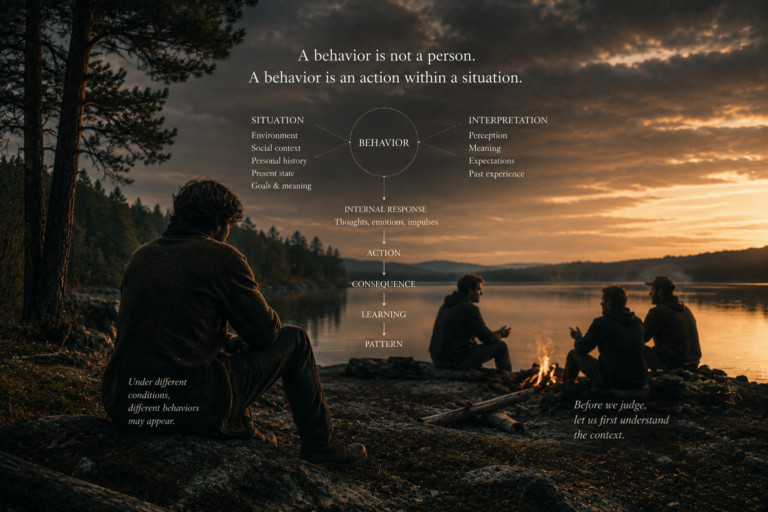
After years of searching for guidance, I realised that I had never been looking to be rescued. I was looking for understanding—for a map of the inner life and the tools with which to navigate it.
After a multitude of difficult and often tragic events, I began my own journey of self-discovery. As a novice student of the workings of my own mind, I sought guidance—not for the purpose of being fixed, but to better understand my inner life so that I might more consciously work with its many, if not nearly infinite, variables.
I sought with both lantern and torch.
Up and down I searched.
In psychiatry, support groups, churches, government institutions, among friends, and within my own family. To my surprise, I rarely found anyone who seemed to understand the premise from which I was working. What I was experiencing did not first appear to me as a problem to be solved, but as something that deserved to be understood. What I needed was not rescue, but the proper tools and the understanding to use them.
If I am going to hammer a nail, I need both a hammer and a nail. I also need to understand what each is and what purpose it serves.
The same, I believed, was true of self-reflection and our relationship to ourselves.
This naturally gave rise to another question.
Why was it so difficult to communicate what I was seeking?
Was I simply failing to express myself clearly? Was I trying to describe something others had never considered? Or did the very suggestion—that one might consciously participate in the cultivation of one’s inner life—challenge assumptions that many of us quietly hold about ourselves? Perhaps I simply spoke in a language that did not translate.
The foundation from which I reason is largely teleological. Teleology refers to understanding things not only by their causes, but also by the ends toward which they are directed. It asks not merely how something came to be, but what purpose it might serve.
From that perspective, I have never been inclined to believe that my experiences arise from ill will alone. Rather, I wonder whether even suffering may participate in purposes that are not immediately visible.
From tragedy to death, from birth to joy, life seems always to move toward something that often escapes precise language.
Yet this way of seeing appears to evoke considerable resistance.
Why?
Do we resist the possibility that much of life unfolds beyond our direct control? Or do we hesitate to believe that hardship might carry meaning beyond our present understanding?
What makes us conclude that tragedy is only tragedy?
There is an old saying:
“What punishments of God are not great gifts?”
Whether one understands this theologically or symbolically, the question has remained with me.
Have not many of our failures become the very things that brought us closer to maturity? Do we not often look back at ourselves from ten years ago with a smile, recognising how little we then understood? If yesterday’s ignorance became today’s wisdom, why should today’s sorrow not also become tomorrow’s teacher?
I was never searching for rescue.
To me, life itself never appeared to be something from which I needed saving. If anything, life seemed to be the miracle that rescued us from never having been at all.
Looking back, I sometimes wonder whether many of those from whom I sought guidance were themselves carrying the quiet conviction that life is, at its foundation, a tragedy.
That thought leaves me with a heavy heart.
For I cannot help but ask:
Is it possible that we have come to regard existence itself as something worse than non-existence?