Physical Address
304 North Cardinal St.
Dorchester Center, MA 02124
Physical Address
304 North Cardinal St.
Dorchester Center, MA 02124

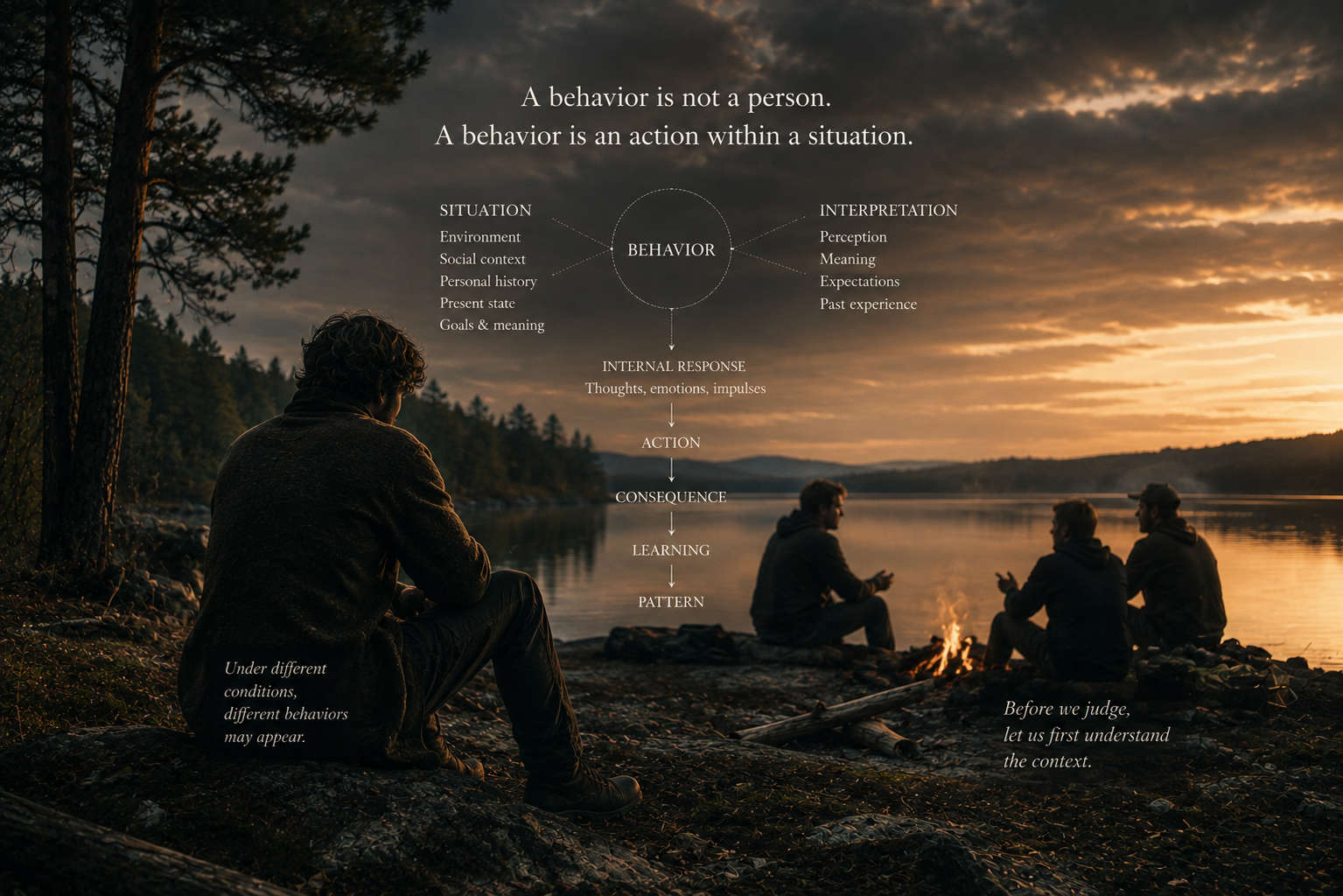
We are quick to turn an action into a characteristic: a person acts restlessly, and we call them restless. Yet behavior does not occur in isolation. It emerges within a particular situation, shaped by history, expectation, present state, and interpretation. Perhaps before deciding who a person is, we ought first to ask what circumstances brought the behavior forth.
While sitting by the water and constructing a fire for the purpose of grilling sausages, it became apparent that the amount of sausage was insufficient. In asking the participants if more ought to be pursued, they could not make up their minds. The apparent lack bothered me, and the indecisive nature of the participants bothered me even more. The answer was very obvious, but a decision wasn’t made.
So I stood up from the ground, where I had been attending to the fire, and made the proclamation that I would be the one who would now go and buy more sausages.
And away I went.
After returning, a question arose:
“Are you always this restless?”
A comment was also made that I, in my person, was neurodivergent, whatever that means. But the man who acts will always seem strange to the passivity of the indecisive, I suppose.
The discussion regarding modern interpretations of what is “normal” is not the subject here. What is interesting is the very common overlooking of the context and situation of a behavior.
For I explained that, in my upbringing, I was surrounded by highly active and restless people. Therefore, my foundational interpretation of social engagements is one of activity: that I ought to be doing something, or that something ought to be happening. This leads me into a heightened state in both nerve and emotion.
Because my energy, after an extended period of activity and social engagement, had become rather diminished, I also had a harder time regulating this responsive interpretation. I explained that a calm state is not something I myself have difficulty establishing in other circumstances, and that calm in social engagement may also be found if the will and concentration are of sufficient capacity.
So the question arose:
What exactly had my companions observed?
Had they observed a restless person?
Or had they observed a person behaving restlessly, in this particular situation, at this particular time, under these particular conditions?
There is a considerable difference between these two statements:
“You are restless.”
“You acted restlessly.”
The first is a statement about a person.
The second is a statement about an action.
To move from the second to the first requires us to make an interpretation. Yet this movement is made so naturally that we may hardly notice that we have done it.
A person speaks harshly, and we call them rude.
A person does not make a decision, and we call them indecisive.
A person moves constantly, and we call them restless.
These interpretations may sometimes be correct. Repeated behavior must tell us something about a person. But before a behavior can be generalized into a characteristic, we ought to ask what produced the behavior in the first place.
A situation is made up of more than the physical circumstances immediately before us.
There is the environment: the place, objects, sounds, temperature, available resources, and physical demands.
There is the social context: who is present, our relationships to them, the roles we occupy, and the expectations of the group.
There is our personal history: upbringing, previous experiences, learned associations, habits, and memories.
There is our present state: fatigue, hunger, emotion, stress, attention, energy, and our present capacity for regulation.
And there are our goals and meanings: what we believe is happening, what matters to us, what we expect, and what we think ought to happen next.
The same external event may therefore constitute very different experienced situations for two different people.
Around the fire, the objective circumstance was rather simple:
There may not be enough sausages.
One person may interpret this as:
“It doesn’t matter.”
Another:
“Perhaps someone should get more.”
My own interpretation was closer to:
“There isn’t enough food. A decision needs to be made. Nobody is making it. I will solve it.”
The external circumstance was shared.
The interpretation was not.
A behavior does not appear from nowhere.
We might, in simplified form, view its progression something like this:
Situation → Attention → Perception → Interpretation → Internal response → Action → Consequence → Learning → Pattern
Something happens.
Our attention is drawn toward certain parts of what is happening. We perceive these through what we already know and expect. We interpret what we perceive. The interpretation produces responses in thought, emotion, nerve, and impulse. We act. The action has consequences.
And those consequences become part of what we bring into the next situation.
If a particular situation is repeatedly interpreted in a similar way, and that interpretation repeatedly produces a similar response, the response may gradually require less deliberation. What was once an action becomes an increasingly familiar way of responding.
If, whenever others hesitate, I act—and my action repeatedly solves the immediate problem—then action becomes increasingly available to me whenever hesitation appears.
We might choose to call this a pattern of behavior.
This does not mean that the pattern is permanent, nor that it represents the totality of the person. It means that under certain conditions a certain response has become familiar.
The easiest and perhaps most relatable example of this is the horrible experience of meeting a person from your youth and seeing, in real time, that you start to behave as a person you no longer respect or recognize.
As if meeting a stranger you had forgotten you knew, you make hand movements foreign to your current interpretation of yourself. Old expressions return. Your voice changes. You become a character that almost feels like a mockery of the person you have become.
Yet, in the horror, there may also be a strange sense of peace and reassurance.
It almost feels like home.
It is safe and recognizable: the welcoming old patterns of behavior that you fall into like falling down onto the sofa after a long day at work.
What a confusing state.
The first time you experience this, you may fall into the trap of believing:
“This is who I truly am.”
But be not fooled by such trickery.
It may simply be something you recognize.
What feels like me may sometimes merely be what is familiar to me.
An old context can make an old response available again. This does not necessarily mean that everything which came afterwards was false, nor that the old behavior reveals some hidden and authentic self.
It may simply reveal that behavior has a history.
This same principle may be observed in the ordinary movements of everyday life.
It may be seen in how you act when you enter your kitchen, how you engage with the radio in the car, or what you do when taking up your phone.
It may also appear in larger matters: making decisions in life, entering difficult conversations, choosing the holidays you look forward to, or returning to the company of certain people.
As the variables that make up a situation change, so too may the behaviors that appear within it.
I have a hard time imagining that anyone on this planet has corrected, acknowledged, or engaged with every interpretation they have formed in relation to every thing, place, person, and situation throughout the progression of their life.
I therefore presume that we all carry actions and behaviors that may no longer fit the circumstances in which we presently find ourselves.
The question is whether we notice them.
Important to note is that recognizing the contextual nature of behavior does not mean surrendering responsibility for it.
We do not necessarily choose every perception, thought, emotion, or impulse that first arises. Nor can every learned response simply be removed through an immediate act of will.
But we may cultivate the capacity to notice, question, inhibit, redirect, and gradually change our responses.
This is not of an easy nature and ought to be respected in its difficulty.
But it should never be forgotten.
If we train our perception toward understanding these patterns of behavior, we may also find a greater understanding not only for ourselves, but for others.
For our judgments themselves arise within contexts. How we perceive another person is influenced by our own history, expectations, present state, and interpretation.
Perhaps, then, we may return to the people with whom we grill sausages with a little more understanding.
Not condemning them through reactive interpretations of who they are and why they are as we perceive them.
Nor excusing every action.
Simply seeing the action for what it is before claiming to know the person behind it.
A person may act in a certain way, in this situation, at this time, under these conditions.
But does this tell us who this person is?