Physical Address
304 North Cardinal St.
Dorchester Center, MA 02124
Physical Address
304 North Cardinal St.
Dorchester Center, MA 02124

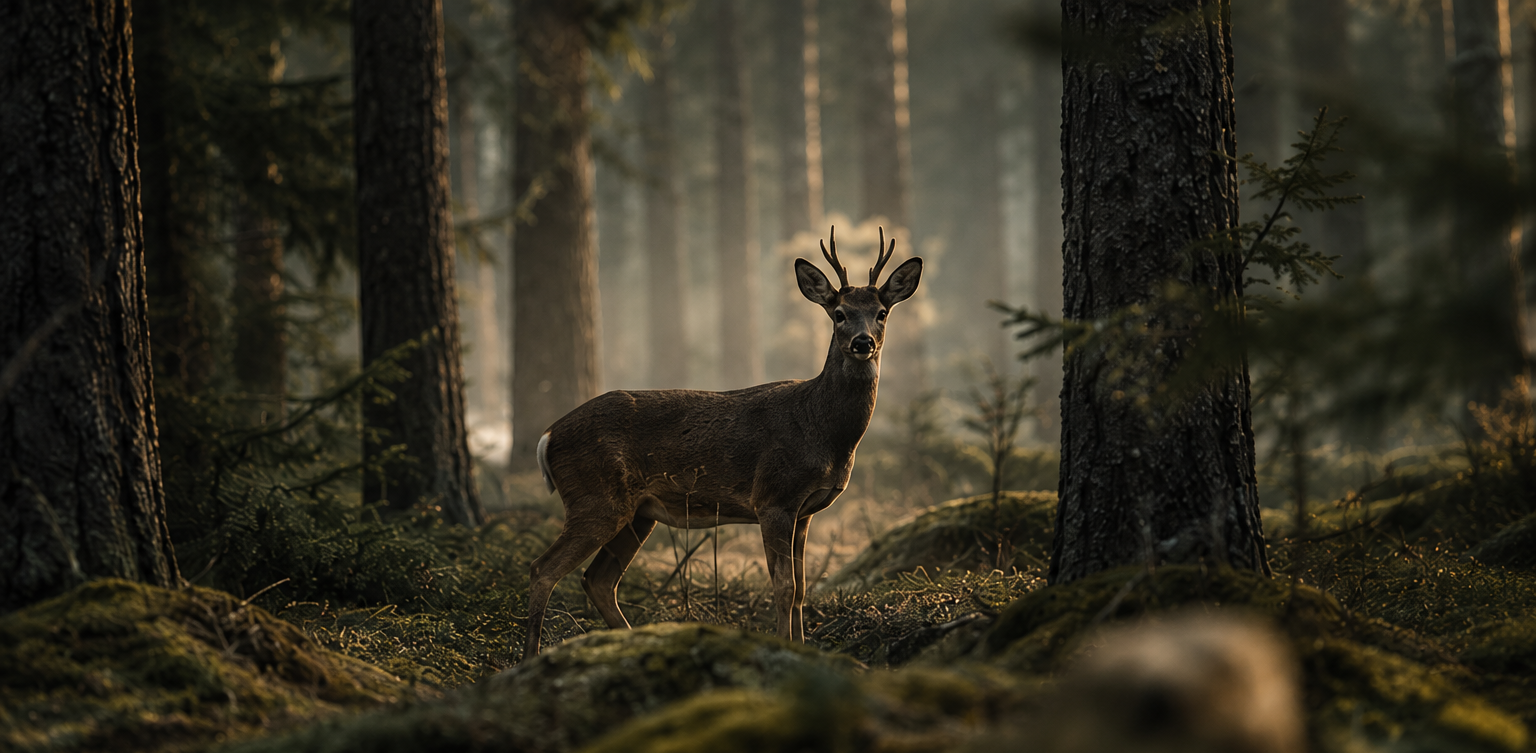
The disappearance of a young buck from a small patch of forest becomes a meditation on fear, change, and the life that quietly carries both deer and man forward.
At seven o’clock one morning, during my daily walk, I found myself standing barefoot in a small patch of forest five minutes from my home.
It is not a large forest—perhaps one or two square kilometres. I imagine it escaped development only because of its inconvenient position atop a steep hill. Like many Swedish forests, it is a landscape of stone, pine, and moss. Though modest in size, it feels dense enough that one quickly loses sight of the world beyond it.
Earlier in the spring I encountered a family of roe deer: a doe and her two fawns. They soon moved on in search of new ground to grace. But a few months later a young buck, his antlers still no more than small sticks, began wandering these woods. I suspect he is one of the fawns I saw with his mother.
For the past couple of weeks we have met almost every morning and afternoon.
It is he I am looking for today.
Barefoot, coffee in hand, I stand upon a small rise overlooking the places where I know he likes to roam. But this morning I cannot find him.
I close my eyes and ask the forest where he might be. I listen intently for the faint crack of twigs or the brushing of branches that usually announce his presence. If I become still enough—if I settle into my heart—I can often sense him before I see him.
Today there is nothing.
A quiet sadness settles over me.
He must have moved on.
The life of the roe deer is a fascinating one.
The first part of life is spent close to the mother, the fawns still marked by the small white spots we all remember from one of the most beloved stories ever told:
Bambi.
(Nerds may point out that Bambi was a white-tailed deer, but true fans know that in Felix Salten’s original 1923 novel, Bambi was, of course, a roe deer.)
Then they leave.
During winter they gather once more. But when spring returns, the doe drives the young males away to fend for themselves.
Now it is the buck against the world.
With antlers scarcely larger than sticks, no territory, and nowhere to belong, he must survive until autumn, when older, stronger bucks compete fiercely for the privilege of passing on their genes. He may die in those contests, or simply fail to breed. Eventually, like all living things, he will return to the soil that once nourished him.
Such is nature.
Perhaps the purest expression of life’s competition.
Unlike man, it is at least honest.
I felt sorrow for this young buck.
In our conversations, he confessed how frightened he was. Once, I think I saw a tear in his eye, though it may just as well have been my own.
For who cannot recognize themselves in a young buck standing in a small patch of forest, not knowing where to go?
Surrounded by roads and the constant roar of traffic, separated from everything you once knew.
And all that is required of you is something you have never before experienced nor acted upon:
A little courage.
Yet alongside his fear there was also curiosity and excitement.
He told me that ideas such as courage are a burden carried mostly by human beings. To be courageous, you must first possess the ability to hesitate—to stand undecided, responsible for choosing your own path. Only then can you fear choosing wrongly, distrust life itself, or doubt the unseen forces that guide it.
“Even if I feel these emotions as well,” he said, “the thought that there is a wrong way has never occurred to me, and never will.”
Then he bounded away into the forest.
That was the last time I saw the young buck.
I have a feeling I never will again.
Curiously, that thought balances my sadness with hope.
I am simply grateful that our paths crossed during such an important season of his life.
Perhaps the unwavering life force of a young buck carries an eternal truth—one that belongs equally to deer and to man.